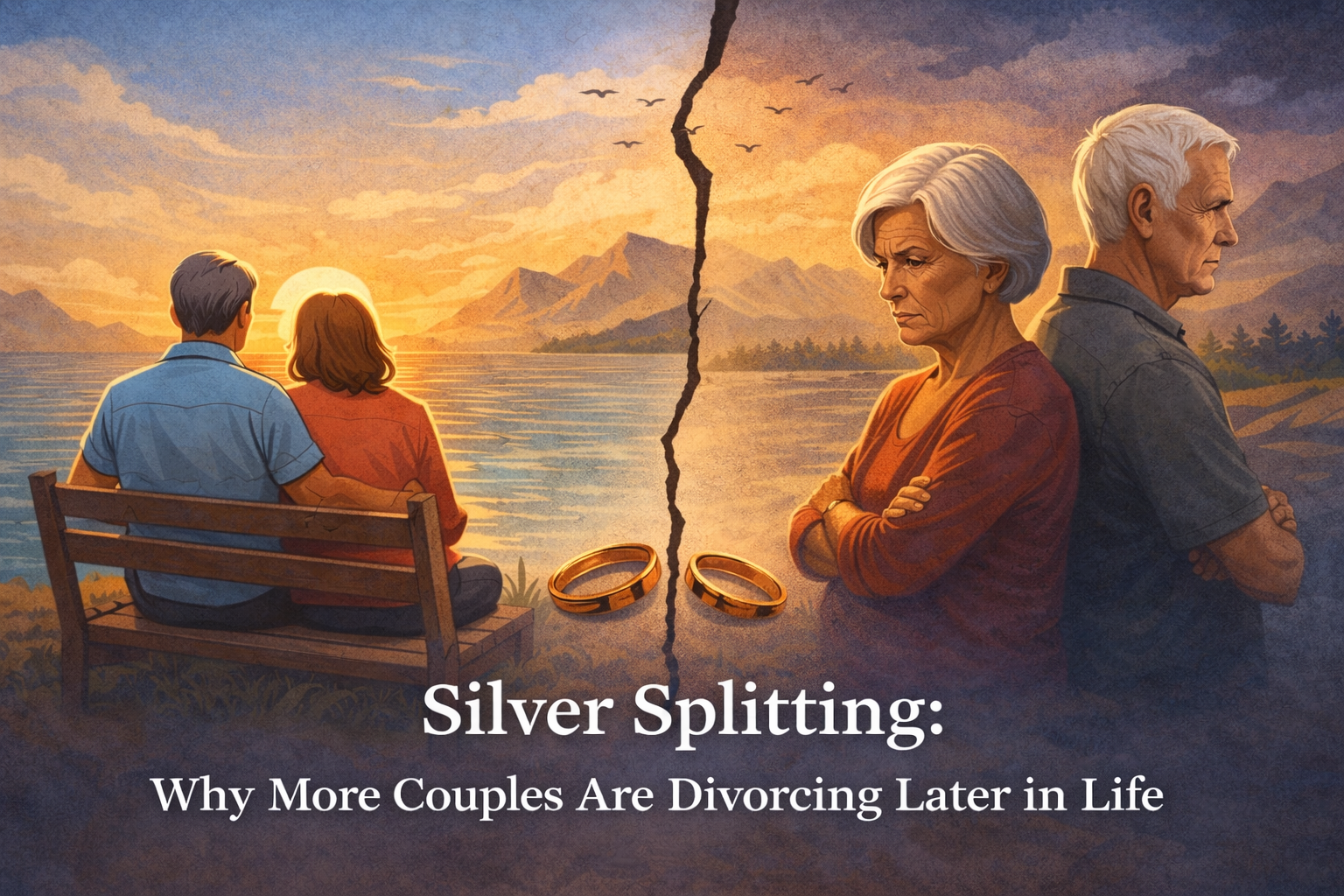
Silver Splitting | Why More Couples Are Divorcing Later in Life
When we look at the statistics around divorce, an interesting and slightly unexpected trend begins to emerge. For most age groups, divorce rates have been declining for years. Since the early 2000s, overall divorce numbers in many Western countries have gradually fallen. In general, fewer people are ending their marriages than they were two decades ago.
At first glance, that sounds like a positive shift. It suggests that relationships may be becoming more stable, or at least that fewer couples are choosing to separate.
However, hidden within those broader statistics is a very different story.
While divorce rates for younger couples have gone down, one demographic group has moved in the opposite direction. Among people aged 65 and over, divorce has increased significantly. In fact, the number of later life divorces has roughly doubled since the early 2000s.
This phenomenon has even gained its own name. It is often referred to as “silver splitting”.
The more you look into this trend, the more fascinating it becomes. Why are people who have spent decades together choosing to separate later in life? What is changing in our relationships as we approach retirement and the next chapter of our lives?
And perhaps most importantly, if we want our own long term relationships to thrive in later life, what should we be thinking about now?
Understanding the Data
To understand the trend properly, it helps to look at the broader context.
In England and Wales, data from the Office for National Statistics provides a useful picture of how divorce patterns have evolved. Divorce rates rose sharply in the decades following the legal reforms of the early 1970s. They climbed steadily until reaching a peak in the early 2000s.
Since then, they have been declining.
But while the number of divorces has gone down overall, the average age of people divorcing has steadily increased.
Today, the average age at divorce is around 46.9 for men and 44.5 for women. These figures have been gradually rising for decades. The pattern suggests that divorce is increasingly becoming a midlife or later life event rather than something that mainly happens among younger adults.
The data from recent years is slightly less clear because the ONS stopped publishing some age specific breakdowns after 2020. But the broader pattern remains widely recognised.
Divorce may be less common overall, but when it does happen it is happening later in life.
And among people in their fifties, sixties and beyond, the numbers have been rising.
Why Later Life Divorce Is Increasing
There is no single explanation for silver splitting. Relationships are complex and deeply personal. Every couple has their own story and their own reasons.
However, several broad social changes appear to be influencing this trend.
Longer Life Expectancy
One of the biggest changes in modern life is how long we now live.
Previous generations often experienced later life as a relatively short stage. Lifespans were shorter, health was less predictable, and retirement did not necessarily mean decades of active living.
Today the situation is very different.
Many people entering their sixties can expect twenty or thirty more years of life. Often those years are relatively healthy and active.
That creates a very different perspective on relationships.
Couples may begin to ask a question that previous generations rarely considered in quite the same way. Do I want to spend the next twenty or thirty years living like this?
It is not necessarily about conflict or unhappiness. Sometimes it is simply about a desire for something different.
Changing Expectations of Marriage
Marriage itself has also changed.
In previous generations, marriage was often seen as a lifelong commitment regardless of personal satisfaction. Social pressure and economic dependency played a significant role in keeping couples together.
Today expectations are different.
Marriage is increasingly seen as a partnership built around personal fulfilment, emotional support and shared growth. When those elements disappear, some people feel less obligation to remain in the relationship.
In addition, financial independence has increased significantly, particularly for women. That independence can make it more practical for individuals to leave relationships that no longer feel right.
Retirement and Shared Time
Another major shift occurs when people retire.
Work provides structure, identity and separate daily routines. It also creates natural distance between partners during the day. Each person has their own colleagues, conversations and experiences.
When retirement arrives, those patterns change dramatically.
Suddenly couples may find themselves spending far more time together. For some relationships this is a wonderful transition. It allows couples to enjoy shared experiences and rediscover time together.
For others it can expose tensions that were previously hidden beneath busy schedules.
Without work acting as a buffer, couples may realise they have grown apart or that they struggle to navigate their lives together without the structure they once relied on.
Identity and Midlife Change
Midlife and later life often bring significant identity changes.
For many people, work forms a large part of how they see themselves. A career can provide purpose, recognition and a sense of contribution.
When work ends or begins to fade into the background, that identity can feel uncertain.
People may experience a period of emotional adjustment. Some feel liberated, while others feel lost. There may be moments of anxiety, irritability or restlessness as individuals try to redefine who they are without the professional roles they once held.
If both partners are going through this identity shift at the same time, it can place additional strain on the relationship.
Each person may be trying to rediscover themselves while also navigating the expectations of the partnership.
The Empty Nest Transition
Another common life transition happens around the same time. Children grow up and leave home.
For many couples, raising children has been the central shared project of their lives. Parenting provides daily routines, responsibilities and a strong sense of purpose.
When that phase ends, couples may suddenly find themselves facing a quieter house and a different rhythm of life.
Some rediscover each other in this new stage. Others realise that their relationship was built largely around parenting rather than a deeper connection.
Again, this does not necessarily mean the relationship was unhappy. It simply means that the foundation of the relationship is changing.
The Question of the Next Chapter
Perhaps the most powerful factor behind later life divorce is simply reflection.
As people approach retirement or enter their sixties, they often begin thinking about the next chapter of their lives.
There is an awareness that time is finite. The future may still hold decades of opportunity, but those decades feel more visible and more precious.
That awareness can prompt important questions.
How do I want to spend the next stage of my life?
What experiences matter most to me now?
And who do I want to share those experiences with?
For some couples, these reflections strengthen their bond. They begin planning the future together with renewed energy.
For others, the answers to those questions lead them in different directions.
The Importance of Communication
While the causes of silver splitting are complex, one theme consistently appears in discussions about strong relationships.
Communication.
Good communication is often the difference between couples who grow together and those who gradually drift apart.
This does not mean that communication is always easy. It rarely is. Even strong relationships require effort, patience and honesty.
But when couples talk openly about their hopes, fears and expectations for the future, they are far more likely to navigate change successfully.
One of the most valuable conversations couples can have is about the future beyond work.
Instead of focusing only on finances or travel plans, it can be helpful to ask deeper questions.
What does a fulfilling next ten years look like for you?
What are you most excited about in retirement?
What worries you about this stage of life?
What would you like to experience more of in the future?
What would you like to leave behind?
These conversations create space for understanding and alignment.
Exploring Time Together and Apart
Another important conversation revolves around time.
Retirement often brings a dramatic shift in how time is spent. Couples who once saw each other mainly in the evenings may now share entire days.
Some couples thrive with this change. Others benefit from maintaining individual interests and activities.
It can be useful to explore questions such as:
What activities do we love doing together?
What hobbies or interests do we enjoy separately?
What new experiences might we like to try as individuals?
What would we love to explore as a couple?
These discussions help couples design a lifestyle that respects both shared connection and personal independence.
Creating Shared Projects
One powerful way to maintain connection in later life is through shared projects.
When children leave home and careers begin to slow down, couples sometimes lose the sense of working towards something together.
Creating a new shared purpose can strengthen relationships.
This might involve volunteering, travelling with a purpose, learning new skills or becoming involved in community activities.
Some couples start charitable initiatives or mentoring programmes. Others focus on creative pursuits, fitness goals or cultural exploration.
The specific activity matters less than the shared experience.
A project gives couples something to build together and something to look forward to.
Understanding That Divorce Is Sometimes the Right Choice
It is important to acknowledge an uncomfortable truth.
Not every marriage is meant to last forever.
For some individuals, later life divorce may genuinely be the healthiest and most honest choice.
Remaining in a relationship that no longer works simply because it has lasted a long time may not serve either person well.
Silver splitting does not necessarily mean failure. Sometimes it reflects a desire to live the remaining years of life in a way that feels authentic.
Recognising that reality does not diminish the value of long relationships. It simply acknowledges that human lives and partnerships evolve.
The Role of Relationships in a Good Life
One of the most famous studies on human happiness comes from the Harvard Study of Adult Development.
Psychiatrist Robert Waldinger, who directs the study, summarises its findings in a simple but powerful statement.
The quality of our lives is largely determined by the quality of our relationships.
Strong relationships support emotional wellbeing, physical health and overall life satisfaction.
As we approach the next chapter of our lives, it becomes increasingly important to nurture the relationships that matter most.
For many people, the relationship with a long term partner is at the centre of that effort.
Final Thoughts
The rise of silver splitting reflects profound changes in how we live, work and think about relationships.
Longer lifespans, changing expectations and the transition into retirement all reshape the dynamics of marriage.
While some couples may grow apart during these transitions, others find new ways to strengthen their connection.
The difference often lies in awareness, communication and shared intention.
As we think about our own future, it may be helpful to pause and reflect on the relationships that have shaped our lives.
What do we want those relationships to look like in the years ahead?
How can we support each other as we navigate the changes that come with midlife and beyond?
And what kind of life do we want to build together in the decades that remain?
These are not easy questions. But they may be some of the most important ones we ever ask.