The Pension Tax Change That Could Reshape Your Retirement and What to Do About It
There is a significant change coming to the UK tax system, and it has the potential to affect around 49,000 families. Quite possibly yours.
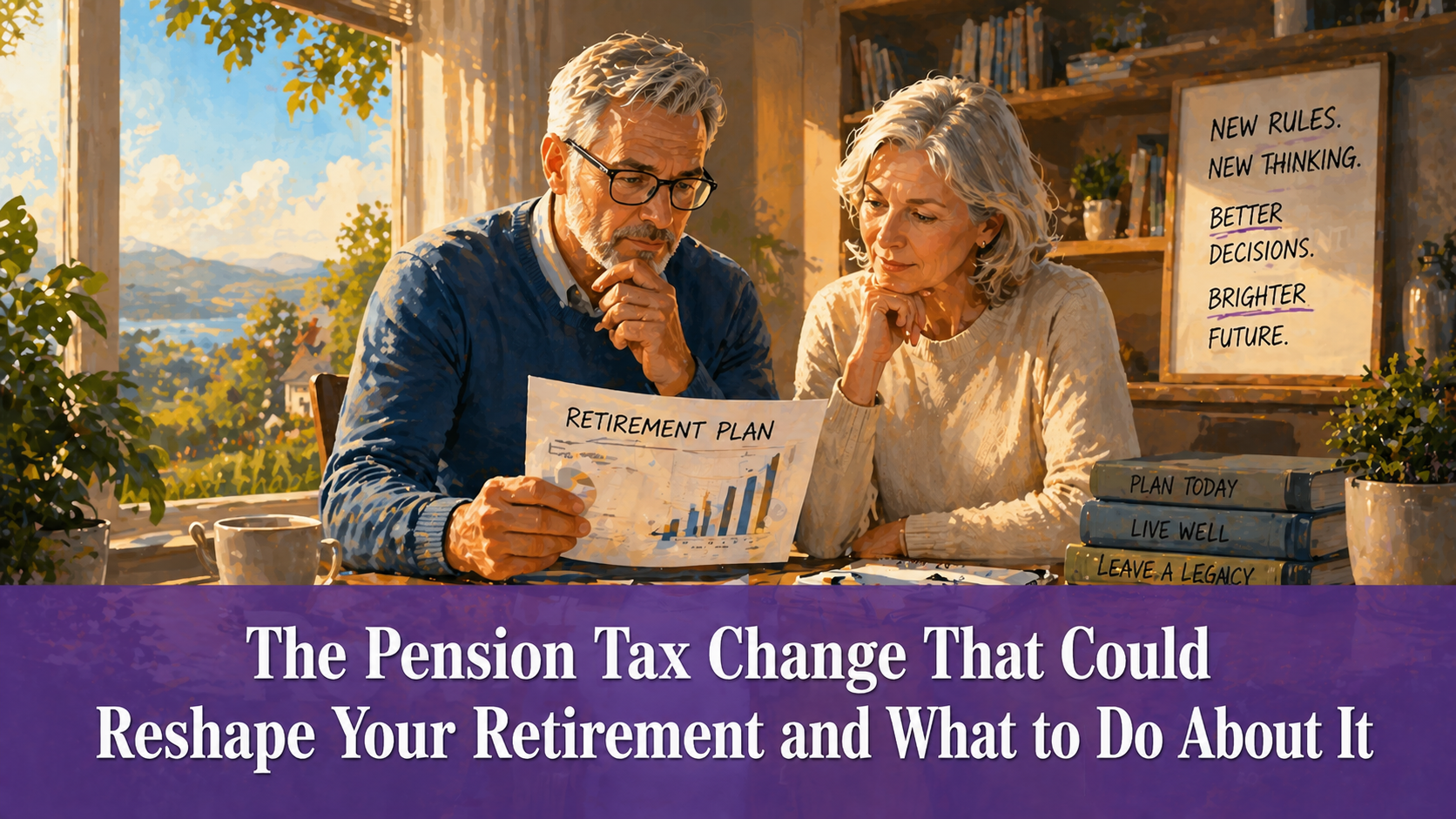
From 6 April 2027, unused pension funds will be brought into the scope of inheritance tax for the first time. This is not a small technical adjustment. It is a meaningful shift in how pensions are treated when it comes to passing wealth on.
This is not about creating fear. It is about giving you time to think clearly and act deliberately.
One of the most valuable things you can do when it comes to financial planning is to understand changes before they arrive. That way, you can respond calmly and intelligently rather than reacting under pressure at the last minute.
This change is not just about tax. It is about how you think about your money, your retirement, and what your wealth is really for.
What Is Actually Changing
At the moment, most defined contribution pensions, such as workplace pensions or SIPPs, sit outside your estate for inheritance tax purposes. This has led many people to adopt a particular strategy.
They spend from ISAs or savings first and leave the pension untouched, often with the intention of passing it on tax efficiently.
From April 2027, that changes.
Pensions will be included in your estate for inheritance tax purposes. The standard rate remains at 40 percent, and the allowances remain the same for now.
You have a nil rate band of £325,000. This means that anything below that amount can be passed on without inheritance tax. There is also an additional £175,000 allowance if you pass your main residence to direct descendants.
For married couples or civil partners, these allowances can be combined, meaning up to £1 million may be passed on without inheritance tax.
However, these thresholds are currently frozen until 2030. As your assets grow in value over time, it becomes more likely that your estate will exceed those limits.
Adding pensions into the equation increases that likelihood.
Why This Matters Now
This change matters because it alters long standing assumptions about how to structure your finances.
Many people have built plans around the idea that pensions are a tax efficient legacy tool. That idea is now being challenged.
Research suggests that around half of UK adults are already considering changes to their retirement or estate plans in response to these rules.
One of the most common shifts is this.
Spending more money while alive.
That sounds simple. In reality, it is often one of the hardest things to do.
The Psychological Shift Around Spending
If you have spent decades saving, investing, and being disciplined with money, switching into spending mode can feel uncomfortable.
Even when you know you can afford it, there is often hesitation.
You might think
We should not touch the pension because it is for the children
We need to be careful in case we run out
We have always been cautious, so we should stay that way
These thoughts are understandable. But they can also become limiting.
The Stoic philosopher Seneca once wrote that we suffer more in imagination than in reality.
That feels particularly relevant when it comes to retirement.
The fear of running out of money can become so powerful that it prevents people from enjoying the life they have worked so hard to build.
So it is worth asking a simple question.
What is the money actually for?
Rethinking the Purpose of Your Wealth
Money is not just about accumulation. At some point, it becomes about use.
For many people, the purpose of wealth in later life is to support wellbeing, health, relationships, and meaningful experiences.
It is there to help you live the life you want, particularly in the earlier years of retirement when your health and energy are strongest.
This is where the tax change, frustrating as it may feel, can also be seen differently.
It can act as a prompt to use your money more intentionally.
There is a well known book that explores this idea. Die with Zero by Bill Perkins encourages people to think about how and when they use their money, rather than simply focusing on how much they leave behind.
Most people do not aim to reach zero. But the principle is useful.
Use your money when it can have the greatest impact on your life and the lives of the people you care about.
Step One: Understand Your Estate
The first practical step is to get clarity.
Add up everything you own. This includes your home, any other properties, savings, investments, ISAs, and pensions.
Once you have that number, you can assess whether your estate is already above inheritance tax thresholds or likely to be in the future.
If it is, this is where professional advice can be incredibly valuable. A financial planner can help you build a strategy tailored to your situation.
Step Two: Review Your Withdrawal Strategy
If your current plan is to avoid touching your pension and leave it as a tax efficient legacy, it may no longer be the best approach.
Instead, it may make sense to draw more from your pension over time, within sensible tax limits.
That money can be used to improve your own quality of life or to support your family while you are still here to see the impact.
Gifting becomes an important part of this conversation.
You have annual gifting allowances, and larger gifts can fall outside your estate if you live for seven years after making them.
There are also rules that allow you to gift surplus income if it does not affect your lifestyle.
Step Three: Rethink ISAs and Pensions
For years, the common approach has been to use ISAs first and pensions second.
With pensions now included in your estate, a more balanced strategy may be appropriate.
ISAs allow tax free withdrawals, while pensions are taxed when accessed. The right mix will depend on your circumstances, but it is worth reviewing this carefully rather than relying on old assumptions.
Step Four: Clarify What Matters to You
This is not about tax. It is about values.
What is most important to you when it comes to your money
Is it leaving a legacy
Is it supporting family during your lifetime
Is it enjoying your own experiences
There is no right answer. But you need to be clear on your own priorities.
Once you are clear, your financial decisions become much easier to align.
Step Five: Give Yourself Permission to Spend
This is the step that rarely gets talked about, but it is often the most important.
Many people struggle to spend money, even when they can afford to.
But research into retirement wellbeing shows that people who invest in experiences, relationships, and personal growth tend to be happier and healthier.
So ask yourself
Is there a trip you have been putting off
Is there something you could do to improve your health
Is there a way to help your family now rather than later
There is also something powerful about giving with a warm hand. Seeing the impact of your support while you are still here can be far more meaningful than leaving it behind.
Finding the Right Balance
None of this is about being reckless.
It is about balance.
You still need to ensure that you have enough to live the life you want for the long term. Financial security matters.
But beyond that, the question becomes how you use your money, not just how you protect it.
This tax change, while frustrating for many, may actually encourage a healthier relationship with money.
It nudges people to think more actively about how their wealth is used.
Looking Beyond Money
It is also worth remembering that retirement is not just a financial transition.
It is a life transition.
It involves questions about purpose, identity, relationships, and health.
Money is part of the picture, but it is not the whole picture.
When people struggle in retirement, it is often because they have focused only on the financial side and not on what comes next more broadly.
That is why it is so important to think about your life as a whole.
A Final Question to Consider
Your pension was built to fund your life.
It was designed to be used.
If you knew that the most sensible and honest thing to do was to spend your money deliberately in a way that enhances your life, what is one small thing you would do first
Because often, that first step is where everything begins to change.