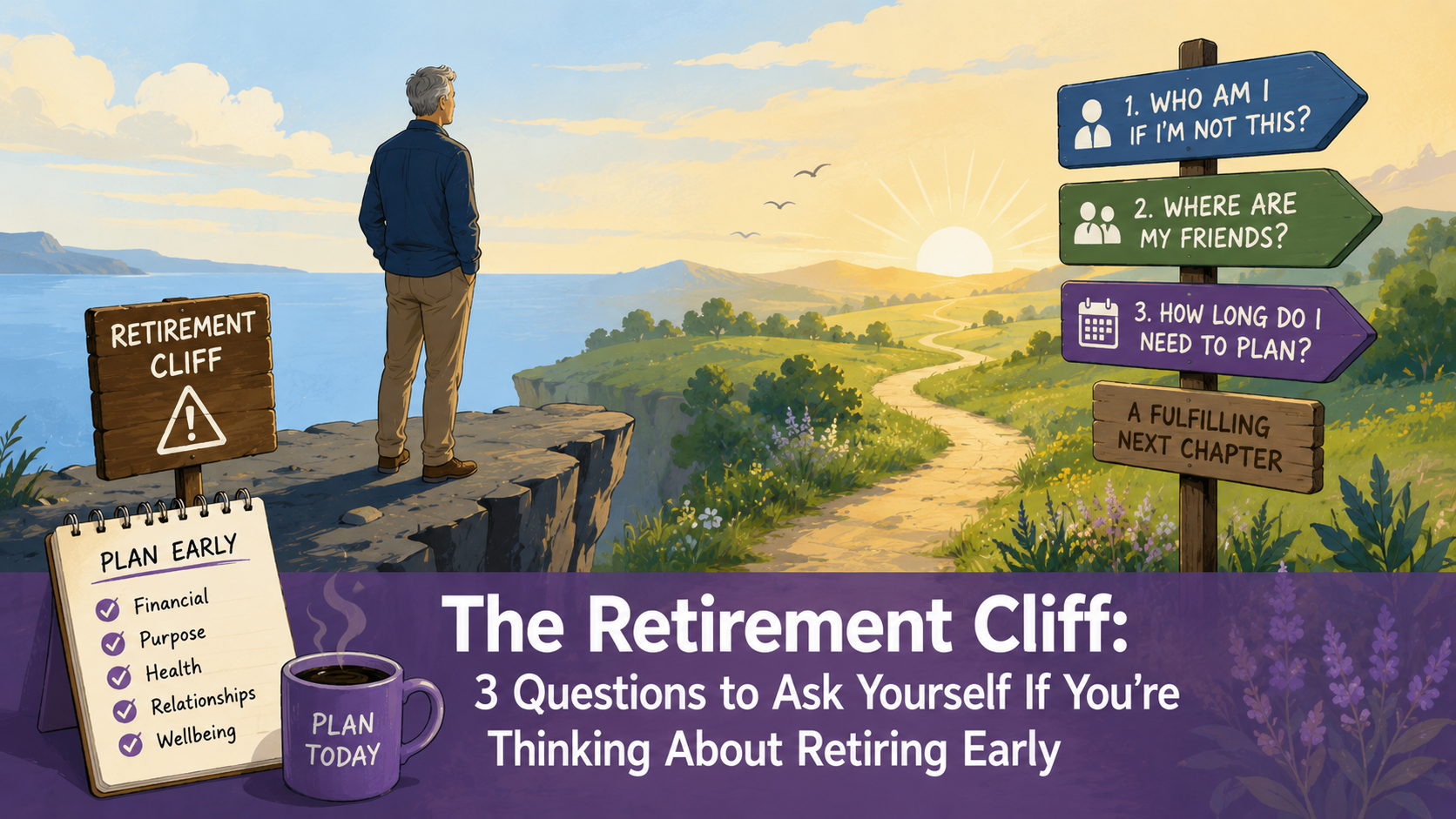
The Retirement Cliff | Three Questions to Ask Before You Retire Early
Retiring early can sound like the dream.
No more Monday morning rush. No more packed calendar. No more pressure from clients, colleagues, deadlines or targets. No more squeezing life into the edges of work.
For many people, early retirement represents freedom. It is the reward for decades of effort, discipline, saving and planning. It is the point at which you finally get to choose how you spend your time.
But there is a danger in thinking about retirement only as something you escape into.
Because retirement is not just the end of work. It is the beginning of a completely different chapter.
And if you do not plan that chapter carefully, there can be a cliff edge.
The retirement cliff is not always financial. In fact, many people who retire early have done a very good job of preparing financially. They have saved, invested, built pensions, sold businesses, paid down debt and created a level of financial independence.
On paper, they are ready.
But life after work is not lived on paper.
The harder questions are often not about money. They are about identity, friendship, purpose, structure and meaning.
Who are you when work no longer defines your week?
Where do your relationships come from when you are no longer surrounded by colleagues?
How long do you need to prepare emotionally, socially and practically for the next stage of life?
These are the questions that many people wish they had asked earlier.
So if you are thinking about retiring early, selling a business, stepping back from work or making a major life transition, here are three questions worth asking before you reach the edge.
Why Planning Early Matters
Most people understand the importance of planning early from a financial point of view.
If you want to retire comfortably, you need to think about pensions, investments, savings, spending, tax, income and long-term security. The earlier you start, the more time you give yourself to build wealth and make thoughtful decisions.
That matters.
Financial planning can give you confidence. It can help you understand whether you have enough, what your options are and how sustainable your lifestyle might be.
But money is only one part of retirement planning.
A good retirement plan should not simply answer the question, “Can I afford to stop working?”
It should also answer, “What am I going to do when I do?”
This is where many people are less prepared.
They spend years planning the financial mechanics of retirement, but very little time planning the life they are retiring into.
That imbalance can create problems.
Because work gives us more than income. It gives us structure. It gives us contact with other people. It gives us status, routine, challenge, achievement and identity.
Even if you do not love your job, it probably plays a bigger role in your life than you realise.
When it disappears, something has to replace it.
That replacement does not happen automatically.
This is why planning early matters. Not just decades early for your pension, but years early for your lifestyle, your relationships, your wellbeing and your sense of self.
Question One: Who Am I If I Am Not This?
The first question to ask yourself is perhaps the biggest:
Who am I if I am not this?
That might sound philosophical, but it is deeply practical.
For many people, work is not just something they do. It becomes part of who they are.
You might be a business owner, a senior leader, a professional, a specialist, a founder, a teacher, a planner, a doctor, an engineer, an adviser, a manager or the person everyone comes to when something needs sorting.
Over time, that role can become woven into your identity.
It affects how others see you. It affects how you see yourself. It gives you a place in the world.
So what happens when that role changes or disappears?
If you sell your business, are you still a business owner?
If you retire from a profession, are you still that professional?
If people no longer need you in the same way, where does your sense of usefulness come from?
These questions can feel uncomfortable, which is why they are so important.
Identity is usually multifaceted. You are not just one thing. You might be a parent, partner, friend, neighbour, mentor, volunteer, creative person, sports enthusiast, traveller, reader, grandparent, gardener, campaigner or learner.
But during busy working years, some parts of your identity may dominate while others are pushed into the background.
Retirement can create space for those other parts to grow.
The challenge is that you need to know what they are.
The Risk of a One-Dimensional Identity
There is nothing wrong with being proud of your work.
In fact, a strong working identity can be a good thing. It may reflect years of effort, skill, service and commitment.
The problem comes when work becomes too much of who you are.
If your status, purpose, routine, friendships and self-worth all come from work, then retiring can feel less like freedom and more like disappearance.
Some people feel this especially strongly after selling a business.
For many business owners, the business is personal. They built it. They shaped it. They carried the risk. They made the decisions. They solved the problems. They were needed.
Then one day, the business is sold.
Financially, this may be a success. Emotionally, it can be disorientating.
This is one reason some business owners sell a business and then quickly start another one. They may say they are doing it for the opportunity, and that may be true. But sometimes they are also trying to regain an identity that suddenly disappeared.
The same can happen in employment. Someone retires from a senior role and suddenly finds that the phone rings less. Emails stop. Invitations slow down. Decisions are made without them.
It can feel like a loss of relevance.
That does not mean retirement was the wrong decision. It means the identity transition needed more attention.
Building an Identity for the Next Chapter
A healthier approach is to start widening your identity before you retire.
Ask yourself:
What gives me purpose outside work?
What values do I want to live by in the next chapter?
What roles do I want to grow into?
What parts of myself have been neglected during my working life?
What would still make me feel useful, connected and alive?
This does not need to be dramatic. You do not need to reinvent yourself completely. But you do need to think about who you are becoming.
Perhaps you want to mentor younger people. Perhaps you want to write, volunteer, travel slowly, help with grandchildren, support a local cause, learn a craft, build a community project, teach, coach or simply become more present in your relationships.
The key is to avoid stepping out of one identity without developing any others.
Retirement is not an identity vacuum. It is an opportunity to reshape your life around what matters now.
But that takes intention.
Question Two: Where Are My Friends?
The second question is simple, but powerful:
Where are my friends?
This matters more than many people expect.
During working life, social connection often happens automatically. You may have colleagues, clients, suppliers, peers, team members and professional contacts. You see people in meetings, corridors, offices, calls, conferences and events.
Some of those relationships may be deep friendships. Others may be lighter social connections. But they all create contact.
When you retire, that contact can reduce dramatically.
This can be one of the biggest shocks of retirement.
You may discover that many of your friendships were connected to a shared environment. When you are no longer in that environment, the relationships change.
That does not mean they were fake. It simply means they were supported by work.
When work disappears, the natural rhythm of those relationships may disappear too.
You no longer see people every day. You are no longer involved in the same challenges. You are no longer part of the same conversations. They are still busy in the world you have left, while you are trying to build a new one.
That can be lonely.
The Hidden Social Role of Work
Work provides more social connection than many people realise.
Even if you would not describe your colleagues as close friends, they still provide daily interaction. Small talk. Shared jokes. Mutual frustration. Problem-solving. Recognition. The feeling of being part of something.
When that goes, the week can become quiet very quickly.
This is particularly important for people whose closest relationships outside family are mainly work-based.
If most of your social world is attached to your job, then retirement can remove a large part of your social life at the same time as it removes your professional role.
That is a lot of change at once.
And loneliness is not a small issue. It can affect mood, motivation, health and overall quality of life.
The good news is that you can do something about it, but you need to start before you retire.
Friendships Take Time
One of the reasons this question matters so much is that friendships take time to build.
You cannot simply retire on Friday and create a rich social life by Monday morning.
Good friendships are built through repeated contact, shared experiences, trust and familiarity. That process can take months or years.
This is why planning early matters.
If you know that work currently provides most of your social contact, start building relationships outside work now.
Join something. Reconnect with people. Develop hobbies that involve others. Get involved locally. Say yes to invitations. Create regular touchpoints with friends. Make the effort.
This can feel uncomfortable, especially if you have been very focused on work for many years. It may even feel inefficient. But relationships are not built through efficiency. They are built through presence.
You need people in your life who know you beyond your job title.
People who are not simply connected to what you do, but who enjoy who you are.
Designing a Social Life After Work
Think practically about what your social life could look like after retirement.
Who will you see each week?
Who could you call for a walk, coffee or lunch?
What communities could you become part of?
Which friendships would you like to deepen?
Which relationships have faded because work was too busy?
What regular social rhythms could you create?
This might include sports clubs, walking groups, volunteering, faith communities, book clubs, local organisations, learning groups, creative classes or simply regular arrangements with people you care about.
The point is not to fill your diary for the sake of it.
The point is to make sure you do not drift into isolation.
A fulfilling next chapter usually includes good people. Not necessarily lots of people, but enough meaningful connection to feel rooted, seen and supported.
Question Three: How Long Do I Need to Plan and Prepare?
The third question is:
How long do I need to plan and prepare for what happens next?
There is no single answer.
Some people need years. Others need less. Some are naturally adaptable and curious. Others have spent decades in one routine and need more time to adjust.
But one thing is clear: you should not sail into retirement without thinking carefully about how you will spend your time.
The danger is assuming that because you are financially ready, you are ready in every other way.
That is not always true.
Retirement is a major life transition. It affects your routine, relationships, identity, health, purpose and sense of progress.
That deserves preparation.
More Than a Financial Plan
A strong retirement plan should include money, but it should also include wellbeing.
Financial wellbeing matters, of course. But so does physical wellbeing. Intellectual wellbeing. Social wellbeing. Emotional wellbeing. Community wellbeing.
Ask yourself how each of these areas will be supported in your next chapter.
Physical wellbeing: How will you stay active and healthy?
Intellectual wellbeing: How will you keep learning and stay curious?
Social wellbeing: How will you maintain meaningful relationships?
Purpose: What will give you a reason to get up and engage with the world?
Community: Where will you contribute beyond yourself?
Structure: What will your week actually look like?
These questions are not soft or optional. They are central to whether your next chapter feels fulfilling.
A financially secure retirement can still feel empty if your days lack meaning.
Likewise, a modest retirement can feel rich if it contains purpose, connection, health and joy.
Avoiding the Retirement Cliff
The retirement cliff happens when someone moves abruptly from a highly structured working life into an unstructured retirement without enough preparation.
One week, life is full of responsibilities, meetings, deadlines and people.
The next, the diary is empty.
At first, that may feel wonderful. You may enjoy the rest, the freedom and the absence of pressure.
But after a while, questions can emerge.
What now?
Who needs me?
What am I working towards?
Why do I feel flat when I should feel happy?
This can be confusing, especially if retirement was something you had looked forward to for years.
But it is not unusual.
It simply shows that human beings need more than free time. We need meaningful time.
The aim is not to replace work with another version of work. The aim is to create a life with enough rhythm, connection and purpose to feel satisfying.
The Importance of Experimenting Before You Retire
One of the best ways to prepare is to experiment before you fully stop working.
Try things while you are still employed or still running your business.
Test hobbies. Build friendships. Explore volunteering. Take longer holidays and notice how you respond to unstructured time. Reduce hours gradually if possible. Create space to understand what energises you.
Do not wait until retirement to discover whether you enjoy the life you imagined.
Sometimes people have a fantasy of retirement that does not quite match reality.
They imagine endless golf, travel, gardening or relaxation. Then they discover that, while enjoyable, those things are not enough on their own.
That is why experimentation is so useful.
It helps you learn what actually works for you.
You may discover that you need more structure than expected. Or more social contact. Or more challenge. Or more quiet. Or more contribution.
Better to discover that before you leap.
Early Retirement and the Question of Enough
Early retirement creates an extra layer of complexity because you may have a longer next chapter than previous generations expected.
If you retire in your fifties, you may have decades ahead of you.
That is wonderful, but it also means you need to think carefully about what those decades are for.
A long retirement cannot be treated as one extended holiday. Holidays are enjoyable partly because they are breaks from normal life. When every day is free, freedom itself needs structure.
So the question is not only, “Do I have enough money?”
It is also, “Do I have enough life?”
Enough purpose.
Enough connection.
Enough curiosity.
Enough health.
Enough contribution.
Enough reasons to stay engaged with the world.
These are not questions to leave until the first Monday after retirement.
The 60 Paydays Idea
One useful way to think about retirement preparation is the idea of giving yourself a longer runway.
If you are five years away from retirement and paid monthly, you may have around 60 paydays left.
That can be a powerful framing.
Rather than seeing retirement as a distant event, you can see it as something approaching steadily, month by month.
Each payday is not only a chance to build your financial plan. It is also a reminder to prepare your life.
What could you do with those 60 paydays?
You could strengthen your savings.
You could clarify your spending.
You could test your retirement income plan.
You could build friendships outside work.
You could improve your health.
You could start a hobby.
You could discuss expectations with your partner.
You could explore volunteering.
You could think about where you want to live.
You could develop a weekly rhythm that will survive beyond work.
The point is not to panic. It is to prepare.
Planning Does Not Remove Freedom
Some people resist planning for retirement because they associate retirement with freedom.
They do not want another timetable. They do not want to be busy for the sake of being busy. They do not want their next chapter to feel like work.
That is understandable.
But planning does not have to remove freedom. In fact, good planning can protect it.
If you know what matters to you, you can make space for it. If you have thought about your relationships, health and purpose, you are less likely to drift into habits that do not serve you.
Structure does not have to mean rigidity.
It can simply mean having enough shape in your week to support your wellbeing.
You might leave plenty of open space. You might avoid overcommitting. You might intentionally create slow mornings, flexible afternoons or quiet days.
That is still a plan.
A good plan does not control your life. It helps you live it more deliberately.
Start Earlier Than You Think
The strongest message from many people already in retirement is simple:
Start earlier.
Start earlier financially, yes.
But also start earlier emotionally, socially and practically.
Do not wait until work has ended to ask who you are without it.
Do not wait until your diary is empty to look for friends.
Do not wait until the first year of retirement to decide what gives you purpose.
Start now.
Have the conversations. Make the changes. Test the ideas. Build the relationships. Think deeply about what you want this next chapter to feel like.
You do not need to have every answer. Nobody does.
But you do need to begin.
Three Questions to Take Away
If you are thinking about retiring early, here are the three questions to return to:
Who am I if I am not this?
Where are my friends?
How long do I need to plan and prepare for what happens next?
Sit with them honestly.
Write your answers down.
Talk them through with your partner, friends, family or adviser.
Notice where your answers feel strong and where they feel thin.
If you have a clear sense of identity beyond work, that is encouraging.
If you have strong friendships outside your professional world, that is valuable.
If you are already preparing your health, purpose, structure and relationships, you are giving yourself a better chance of thriving.
But if your answers feel uncertain, that is not a failure. It is useful information.
It shows you where to focus.
Retirement Is Not Just Stopping
The real goal is not simply to retire early.
The real goal is to live well.
Stopping work may be part of that, but it is not the whole story.
A fulfilling next chapter is not created by absence alone. It is created by what you choose to add.
More time with people you love.
More attention to your health.
More curiosity.
More contribution.
More alignment with your values.
More space for the parts of you that work may have crowded out.
That is the opportunity.
But opportunities need preparation.
The retirement cliff is avoidable if you start asking the right questions early enough.
So before you step away from work, take the time to think beyond the numbers.
Think about who you are becoming.
Think about who will be with you.
Think about how you will spend your days.
Because the best retirement plans do not just help you stop working.
They help you start living the next chapter with clarity, confidence and purpose.