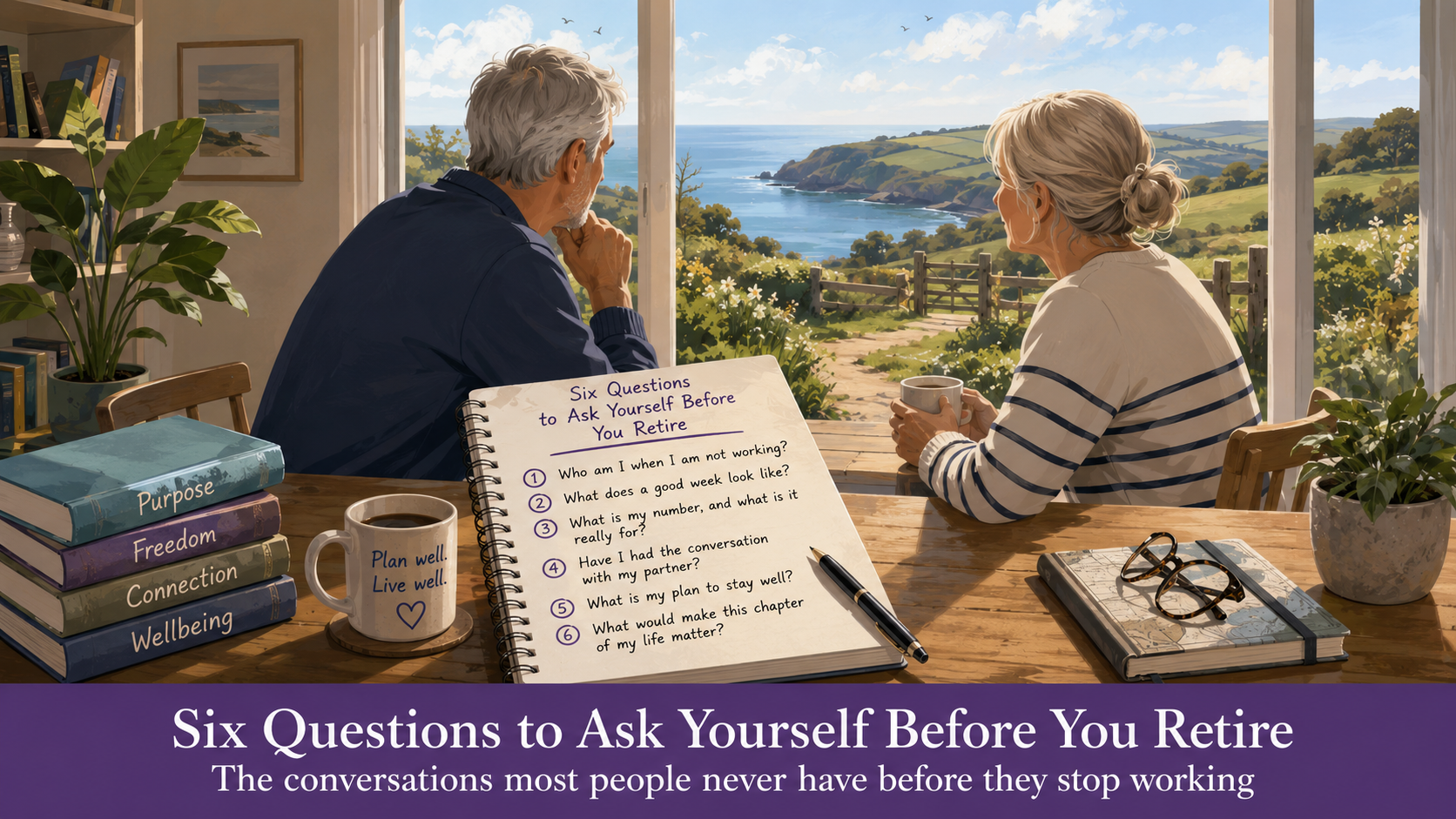
Six Questions to Ask Yourself Before You Retire
The conversations most people never have before they stop working
When someone sits down with me and tells me they are thinking about stopping work, most people expect me to ask about their pension. How much have they got? What age are they thinking? Is the number there yet?
I do get to all of that. But the first question I tend to ask is different. It is this: what are you retiring to? What are you going to do with your time?
You would be surprised how often that lands with a long pause. People who have spent years, sometimes decades, carefully planning their financial exit have given almost no thought to what comes after it. The money question has been answered. The life question has barely been started.
So here are six questions worth sitting with. They are not all financial planning questions. Only one of them really is. The rest are about life. They are the questions that nobody else tends to ask, and they might be the most important ones you will ever put to yourself.
Question one: who am I when I am not working?
This one sounds like it belongs in a therapy session. It does not. It is one of the most practical questions you can ask yourself before you step away from a career.
For most of us, work is not just something we do. It is a significant part of how we understand ourselves. It shapes how we introduce ourselves at dinner parties, how we structure our days, and quietly, how we measure our own worth. Think about the question that almost always comes up within the first few minutes of meeting someone new. So, what do you do?
When you are no longer a managing director, a partner, a teacher, a manager, a consultant, who are you without that label? I am not saying you need a polished answer ready. I am saying it is worth thinking about before you find yourself without one.
The people who struggle most in the first year or two of retirement are often those who had built the majority of their identity around their career. They planned carefully for financial independence. They did not plan for the identity gap that comes with it. So ask yourself: outside of work, what do you stand for? What do you care about? Who would you be if you had never taken the career path you took?
Question two: what does a good week look like?
Not a good holiday. Not a good day off. A good week. An ordinary Tuesday morning. A quiet Wednesday afternoon. A Thursday with nothing in the diary.
Because here is the thing nobody really warns you about. Retirement is not one long holiday. It is the stretch between 2pm and 5pm when you used to be at your desk but now you are not quite sure what to do with yourself. Structure disappears, and many people only realise how much they relied on it once it has gone.
If you share your life with a partner, sit down together and actually map it out. What does Tuesday morning look like? What is filling your time in a way that feels purposeful rather than just busy? If you cannot answer that yet, it is worth thinking about before you fully retire. Not because of the money, but because meaning does not arrive automatically just because the working week has ended.
Question three: what is your number, and what is it actually for?
This is the financial planning question, and it is a good one. Most people think the question is simply: do I have enough? That matters, of course. But the more interesting question is: enough for what?
I have worked with clients who had plenty of money to retire comfortably, but because their idea of comfortable was so vague, they spent the first year of retirement quietly terrified that they were spending too much. And I have worked with clients who, once they were honest and specific about the life they actually wanted to live, realised they were closer to ready than they had thought.
Your number is not just a figure in a spreadsheet. It is the answer to a much more personal question: what does the life I actually want to live cost? Work out the life first. Then work out what it costs. Then you will know what your number really needs to be.
Question four: have you had the conversation with the person you share your life with?
If you have a partner, the next chapter of your life is not an individual decision. It is one of the biggest joint decisions you will ever make. And yet so many couples arrive at this point having planned almost entirely in parallel, never quite sitting down together and asking what they each actually want.
One person imagines travelling. The other imagines a quieter life closer to home. One wants to downsize to the coast. The other has no intention of leaving the house they have loved for twenty years. Nobody is wrong. But if you have not had the conversation, those differences will surface eventually, and it is much easier to work through them before the rubber hits the road.
Where do your visions overlap? Where do they clash? What compromises are you both genuinely comfortable with? Have that conversation now, more than once, with honesty.
Question five: what is your plan to stay well?
Not financially well. Well across the board. Physically, mentally, socially.
Research suggests that the loss of workplace social connection is one of the biggest predictors of poor mental health in retirement. Work, for all its frustrations, gives us structure, routine, status, purpose, and regular human contact. When it goes, the gap can be significant.
What is your plan to stay connected to the world, not just at Christmas or on holiday, but week in, week out? What does physical health look like in this next chapter? What keeps your mind engaged? Wellbeing does not maintain itself, and the next chapter of your life is long enough that it is worth planning for deliberately.
Question six: why would this chapter of your life actually matter?
This is the hardest one, and the most important.
Not what you will do. Not how you will spend your time. But what will make you look back in ten years and feel that it meant something? What would make this a decade worth living, not just a decade that passed?
For some people that is contributing to their community. For some it is finally writing the book or starting the project they have been putting off for years. For others it is simpler than that: it is time with the people they love, watching grandchildren grow up, being present in a way that work never quite allowed.
The point is not to have a grand ambition. The point is to have an answer. Because the alternative, drifting through the next decade without ever really asking the question, is the quiet loss that nobody tends to talk about.
The six questions, one more time
It is worth running through them together.
Who am I when I am not working? What does a good week actually look like? What is my number, and what is it really for? Have I had the honest conversation with my partner? What is my plan to stay well across all areas of my life? And what would make the next ten to fifteen years genuinely matter?
These are not questions with easy answers. Some of them will take time. Some of them will need more than one conversation. But the people who ask them before they stop working tend to navigate the next chapter in a very different way to those who do not.