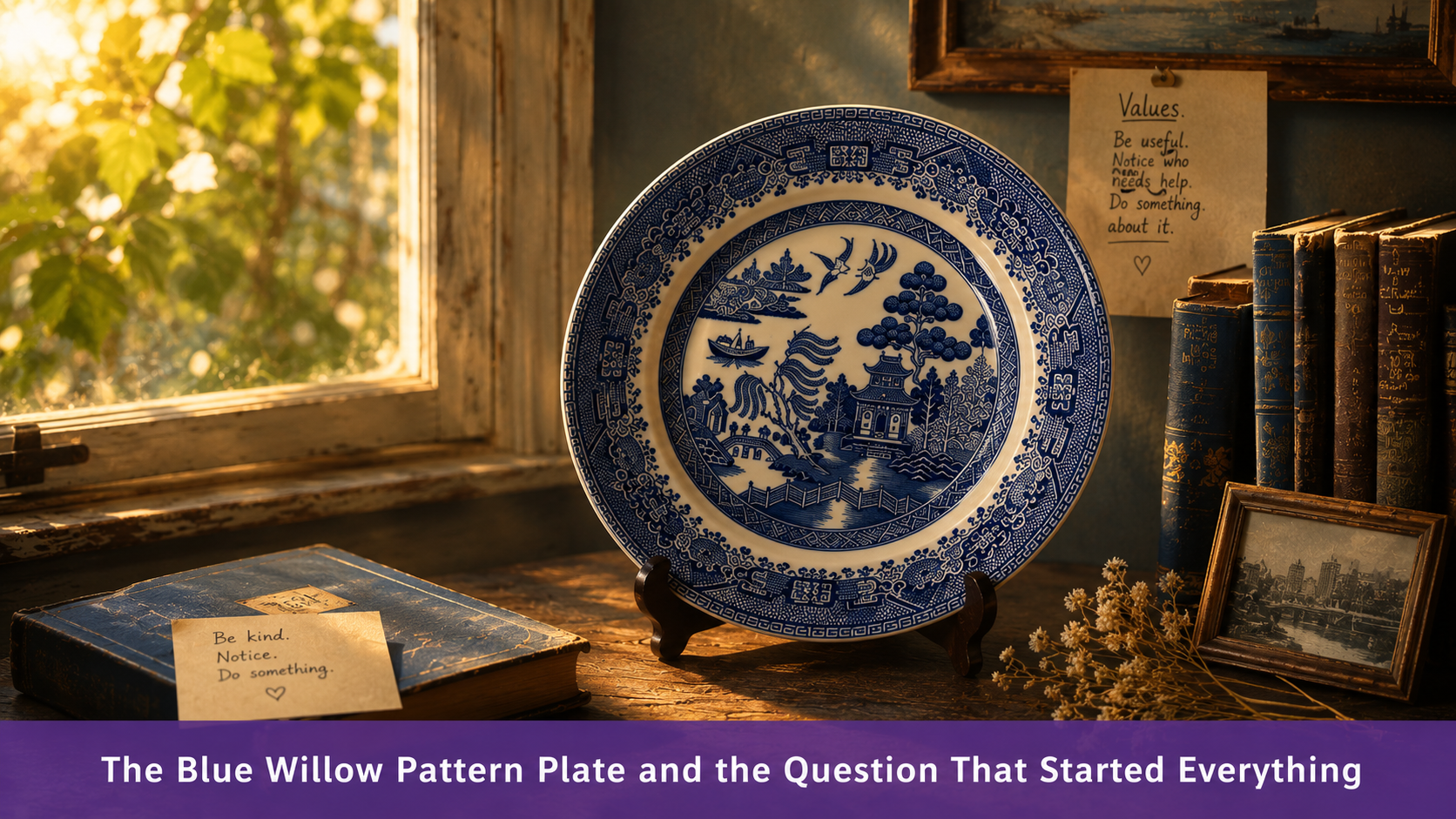
The Blue Willow Pattern Plate and the Question That Started Everything
There is a blue willow pattern Chinese plate sitting in my memory that, in a roundabout way, explains exactly why What Happens Next exists.
Let me take you back. Primary school, East London, mid-1980s. I was the sort of kid who noticed if someone was sitting on their own at break time. Not because anyone told me to, just because it seemed like the obvious thing to do. One day, the school mentioned it in assembly. Stood there in front of what felt like hundreds of other children, my first thought was straightforward: what am I getting?
This was the era of He-Man and Transformers. The gift I actually received was a blue willow pattern Chinese plate. Probably grabbed from the back of a teacher’s cupboard in a hurry. I thought it was a bit rubbish, honestly.
But the school had already rung my mum. And when I got home and saw the look on her face, that was something else entirely. Pure pride. Not in the plate, obviously, but in the fact that her son had grown up to be someone who noticed people and did something about it.
She kept that plate for 35 years. She told me so, not long before she passed away from lung cancer in 2019. Worth virtually nothing in any material sense. Worth everything in every other sense.
The WhatsApp Message That Changed My Thinking
Jump forward a few decades, and I am sitting across from a client I will call Mike. Long career, corporate life, very much the “get it done” type. He came to me with the question I hear regularly: do I have enough to stop?
We ran the numbers. The answer was yes, clearly and comfortably. I told him so.
He looked at me and said he was quitting his job that day.
I asked him to hold on a moment. Not because the finances were wrong, but because I wanted to know what he was actually planning to do with his time. He mentioned a backlog of DIY jobs around the house. I pushed a little. Not to be difficult, but because I genuinely wanted to understand how he thought 40 years of purposeful work was going to feel replaced by home improvements, not for a month or two, but indefinitely.
He told me not to worry.
Three months later, I received a WhatsApp message. A photo of an aeroplane. Underneath it: “Mr Daems, please. This is what retirement has become for me. Do I need to get out more?”
That message planted the seed for this entire project.
The Gap the Spreadsheet Cannot Fill
I have always believed that good financial planning is genuinely valuable work. Helping someone understand they have reached financial independence, or showing them the path to get there, that matters. I stand by it completely.
But Mike showed me something the numbers cannot capture. You can have total financial clarity and still walk out of your final day at work completely unprepared for what follows. The money being right is necessary. It is not sufficient.
A Financial Planning Standards Board study found that 79% of people do not feel ready for retirement. Honestly, that figure does not surprise me. If anything, it might be on the low side. Because the preparation most people do is almost entirely financial, and the financial side, crucial as it is, only tells part of the story.
What does a good day actually look like when every day is a Saturday? What happens to your sense of purpose, your routine, your social world, your identity, when work is no longer providing all of those things simultaneously?
Those are the questions that What Happens Next is built around.
The NEXT Model
One of the central frameworks in the book is something we call the NEXT model. It is designed as an ongoing process rather than a one-off plan, because navigating a major life transition is not something you sit down and figure out once. It keeps evolving.
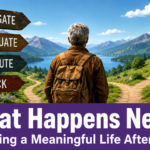
Navigate
Before you start moving, work out where you actually want to go. What does an ideal day look like? An ideal week, month, year? What do you want more of in your life, and what do you want less of? Most people skip this stage entirely because they are too busy finishing work to think clearly about what comes after it.
Evaluate
Once you know where you are heading, take an honest look at where you are right now. If you want to be fit enough to walk a long-distance trail or keep up with grandchildren, but your current fitness levels are not there yet, that gap is not something to feel bad about. It is useful information. It tells you what needs attention.
Execute
This is not about overhauling your entire life in one go. It is about the next small step. What can you actually do this week, or this month, that starts closing the distance between where you are and where you want to be? Small, consistent moves tend to compound in ways that grand plans rarely do.
Track
Notice what is working. Notice what does not feel right. Adjust. Experiment. Try something different. The aim is not rigid adherence to a fixed plan, it is continued forward movement, learning as you go.
If these ideas resonate, two books worth your time are Designing Your Life by Bill Burnett and Tiny Experiments by Anne-Laure Le Cunff. Both go deeper on this kind of thinking.
The Old Model Is Broken
Most of us inherited a particular shape of life without really questioning it. Learn, earn, rest. School, career, retirement. Three chapters, neatly separated, each one replacing the last.
That model no longer holds up, not for wellbeing, not for longevity, and not really for happiness either. The evidence is fairly clear that a life of pure rest, once work ends, tends not to go particularly well for most people. Purpose, continued learning, genuine engagement with the world, these are not optional extras for the restless or the ambitious. They are linked, meaningfully, to how well and how long people actually live.
What we are trying to build with What Happens Next is an alternative to that outdated model. A version of the next chapter that is not simply the absence of work, but a deliberate, designed life that might include some earning, will almost certainly include learning, and will look completely different from one person to the next.
None of what you will find in the book or in these videos is a prescription. Your next chapter is uniquely yours. The job here is not to tell you what it should look like, but to give you enough frameworks, evidence, and prompts that you can work that out for yourself.
What Are You Taking With You?
I think about my mum when I think about this work. About the plate. About what she was proud of, and why.
The value she saw reflected back that day was something like: be useful to people. Notice who needs help. Do something about it.
That value has been at the root of everything I have done professionally, across financial planning, writing, and What Happens Next. It is bigger than any particular job. It travels with me.
So here is a question worth sitting with.
What values are genuinely important to you? Not your job title, not your responsibilities, not the version of yourself that exists because work requires it. The actual values underneath all of that. The things that, once the routine and the identity and the structure of employment are gone, are still fundamentally you.
And which of those values do you want to carry into the next chapter?
That question, more than almost any other, is worth your time. Because the next chapter that actually works is not built on a financial plan alone. It is built on knowing what matters to you, and making sure you do not leave it behind when you walk out of the office for the last time.