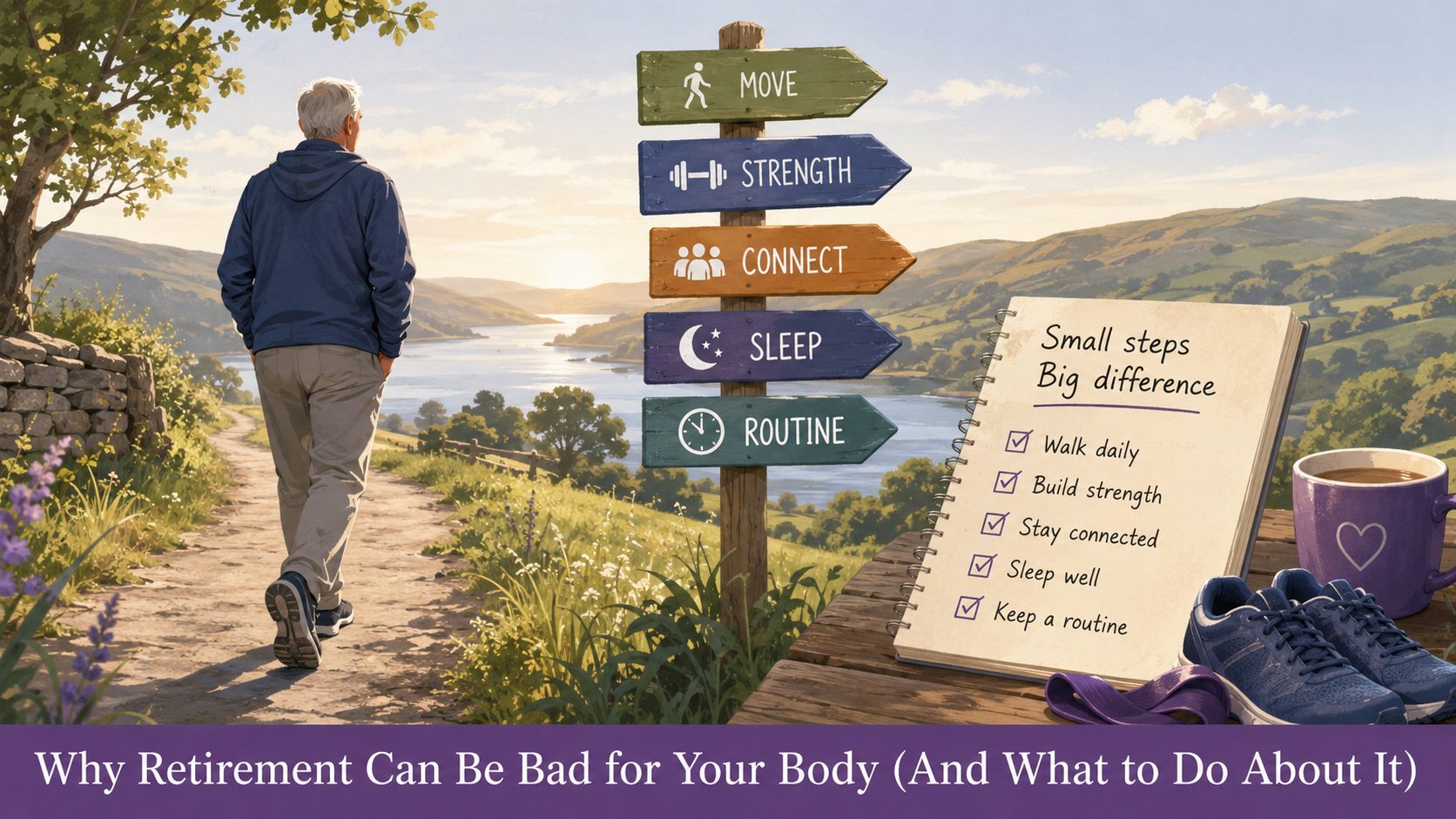
Why Retirement Can Be Bad for Your Body (And What to Do About It)
The physical health conversation most people never have before they stop working
Here is something I probably do not say to clients often enough. Stopping work can actually be bad for your body.
I hold back partly because I do not feel fully qualified to talk about it, and partly because I genuinely do not want to kill the mood. But here is the thing: understanding what work gave your physical health, often without you ever realising it, is one of the most important conversations you can have as you approach the next chapter of your life.
Because the paradox is real. You are about to have more time than ever. More rest, more freedom, more of the things you have been looking forward to for years. And yet the research tells a more complicated story.
What the research actually says
We tend to assume that retirement is straightforwardly good for our health. Less stress, more sleep, more time to focus on ourselves. For some people, that is exactly what happens. If you have had a physically demanding or high-pressure job, stepping back can bring genuine relief. If you are someone who thrives on freedom, you might actually become more active once no one is dictating your diary.
But a 2025 systematic review, published in Ageing and Society, looked at 19 studies and found that 12 of them consistently linked full retirement to declining physical function, increased chronic disease, and higher all-cause mortality risk over time. That is not a reason to panic. It is a reason to be intentional.
Five things work was doing for your body without you knowing
When I talk to people about this, the honest reaction is usually surprise. We do not think of work as a health intervention. But it is, in ways that only become visible once it has gone.
The first is structured movement. Even a desk job involves more movement than we give it credit for. The commute, walking between meetings, popping out for lunch, a coffee run, a quick chat at someone else’s desk. Remove that structure and all of that daily micro-movement disappears with it. Research shows that retirees spend significantly more time sedentary than working adults, not because they are lazy, but because nothing is nudging them to move anymore.
The second is social stimulation. Work is a daily source of human interaction. Small talk in corridors, shared lunches, the colleague who always makes you laugh in a Tuesday morning meeting. These are not just nice to have. They represent a mild but regular form of physical and cognitive engagement that quietly supports our wellbeing.
The third is cognitive demand. There is strong evidence that people with higher levels of cognitive engagement tend to maintain better physical function as they age. When the intellectual demands of work disappear overnight, the body can feel the ripple effect.
The fourth is purpose. Work gives us a reason to get up, get dressed, and get going. Even imperfect, stressful, not-quite-what-we-wanted work. Without it, the morning routine softens. Physical activity shifts from habitual to optional, and it is a surprisingly short slide from ‘I will exercise later’ to ‘I do not really exercise anymore.’
The fifth is routine itself. Human bodies love regularity, even when our minds crave freedom. Regular sleep, regular meals, regular movement all support physical health. Work provided an external scaffold for that routine. When it goes, you need to build a new one deliberately, or things quietly start to slip.
The good news is that every single one of these things is replaceable. None of them require a job to deliver. They just require intention.
Five experiments worth trying
In What Happens Next, we talk a lot about tiny experiments. Small, low-stakes tests that give you real data about what actually works for you, because the next chapter of your life is not a one-size-fits-all prescription. Here are five physical wellbeing experiments worth considering.
1. A daily walk as a non-negotiable
The NHS recommends at least 150 minutes of moderate activity per week as we get older, plus strength and balance work twice a week. But forget about hitting targets for now. Start with one 20-minute walk at the same time every day, not because you feel like it, but because it is a habit. A 2025 study from Texas A&M found that just 20 minutes of exercise at least twice a week can meaningfully slow cognitive decline in older adults. Twenty minutes. That is more than achievable. The question is simply: what time of day could you put your shoes on, walk for 20 minutes, and come back, as automatically as brushing your teeth?
2. Strength training
Walking is brilliant, but it is not the whole picture. Research consistently shows that strength training protects against muscle loss, supports bone density, and helps us maintain the physical independence that makes retirement actually enjoyable. Climbing stairs, carrying shopping, getting up from a chair without pushing off. These things do not happen by accident as we age.
UK research from the University of Manchester found that many recently retired people feel like an invisible population when it comes to strength training. Not frail enough for specialist programmes, but not catered for in most mainstream gyms either. The answer does not have to involve a gym membership. Bodyweight exercises at home, resistance bands, a set of dumbbells in the corner of a room. That is enough to make a meaningful difference.
3. Stack your physical wellbeing with a social element
One of the strongest predictors of whether people actually show up and move their bodies is social accountability. A UK study found that people who exercise with others are far more likely to stick with it, simply because they do not want to let someone down. So they just turn up.
In What Happens Next, we call this wellbeing stacking: finding activities that fill more than one wellbeing bucket at once. A walk with a friend. A group fitness class. A game of padel with someone you like spending time with. You are not just improving your physical health. You are improving your social wellbeing at the same time. The question is: what physical activity could you do with at least one other person this month?
4. Sleep like you mean it
Physical activity gets all the attention, but sleep is the quiet partner that makes everything else work. Retirement changes sleep patterns in ways people do not always expect. Without a reason to be up at a set time, bedtime shifts, wake time shifts, and sleep quality often declines.
The irony is painful. Work was disrupting your sleep, so you left. But without the structure, sleep gets worse, which accelerates the physical decline that retirement was supposed to reverse. The fix is not complicated, but it is not easy either. Protect your sleep window. Keep a consistent wake-up time, even when you do not have anywhere to be. Be honest with yourself about whether daytime napping is creeping in and disrupting your nights.
5. Design your morning deliberately
I am not suggesting a cold plunge at 6am. I am suggesting something much more straightforward: being intentional about how your day starts.
Work gave you a morning routine, whether you liked it or not. Retirement returns that time to you, which sounds like a gift. And it is. But without deliberate design, more time can quickly become less structure, which becomes later movement, which becomes a mid-morning energy crash that takes the rest of the day to recover from.
Try this: before you live your ideal morning, write it down on paper. Not someone else’s ideal morning. Yours. What time do you get up? What is the first thing you do to move your body? When do you eat? If you wrote down your current morning routine honestly, what would be the one thing you would change?
The question underneath all of this
There is a question that sits at the heart of everything we do with What Happens Next, and it is not ‘how do I get healthy?’ That is too big, too vague, and too easy to park indefinitely.
The better question is this: if your body in the next chapter of your life could feel just one per cent better than it does right now, more energy, more strength, more ease in how you move through your day, what is the one tiny experiment you would be willing to try in the next week to start moving there?
Not a full plan. Not a perfect routine. Just one small step forward.
Health really is the foundation beneath everything else. We can have all the financial security and freedom in the world, but the quality of everything depends on our ability to think, feel, and move. So if this has given you something to think about, I would love to know what that one experiment is going to be for you.