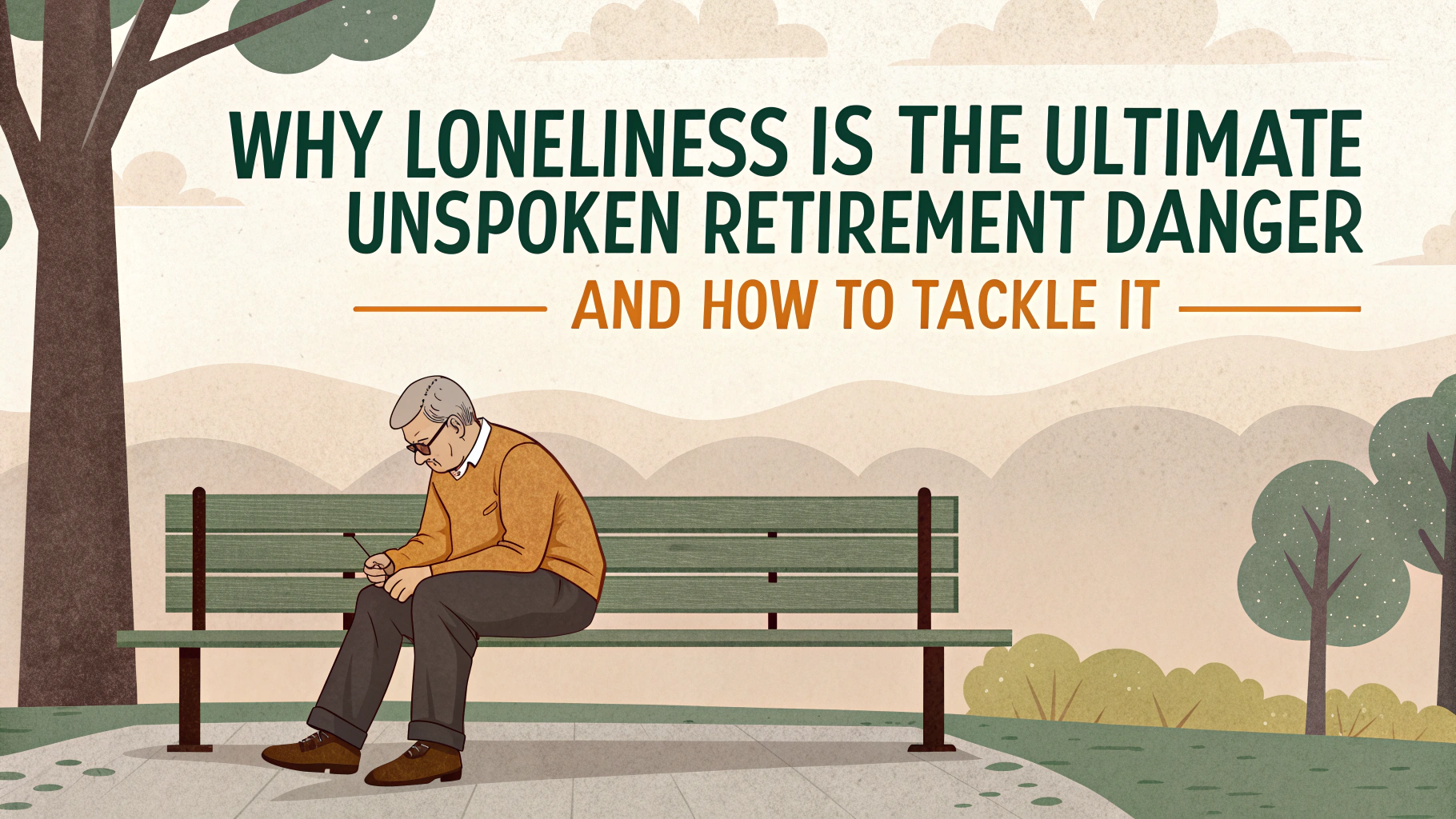
Why loneliness is the ultimate unspoken retirement danger and what the Epicureans can tell us about tackling it.
Loneliness isn’t just a feeling – it’s a health risk.
In fact, according to research popularised by the US Surgeon general Vivek Murphy, chronic loneliness in retirement is equal to smoking 15 cigarettes per day.
Yet over 1.4 million older adults in the UK report feeling lonely quite often with an additional 1.9 million often feeling ‘ignored and invisible’ in their daily lives.
The data on this subject is fascinating and shows a growing gap as we age. You see whilst, on average, we get better at being less lonely the older we are. However, the amount of people 50 and beyond who feel lonely ‘often or always’ doubles when compared to people who are younger.
So, whilst many of us in our 50’s and beyond will be absolutely fine… roughly 1 in 6 of us will experience severe loneliness later in our lives.
But whilst we talk more about loneliness today, we this isn’t a modern problem.
Epicurus, centuries ago, knew isolation was toxic to the soul.
That’s why he established the famous “Ho Kepos”
This meant making the back garden of his house in Athens a place where friends gathered not just to socialise, but to pursue tranquility, wisdom, and a shared purpose.
So, in this blog, I want to talk about how vital friendships and community are when we consider the next step in our lives, how we can learn a lot from the stoics about avoiding loneliness later in our lives and the 3 practical actions we can take today to make sure we’re not that 1 in 6 people who experience chronic loneliness later in our lives.
Whilst the majority of conversations I have about retirement are about money, there’s one conversation which becomes a close second over and above the money.
That’s about friendships.
You see, often we’re lucky enough to work with people we develop good social relationships and friendships with.
However, it’s also natural for these relationships to change when you either retire or decide to do something different.
I remember one story a friend of mine once told me about the fact that, with plenty of time in his diary, he used to pop into the office every now and again. His feeling was the dynamic of the relationships with his workmates, something he valued massively, had changed after he retired.
He still considers them friends but has found that he needed to cultivate relationships outside of work, something he hadn’t done on the run up to his retirement and had to apply a decent chunk of effort to when he realised the majority of his friendships were at work.
The statistics are clear. Most of us are pretty good at improving our social wellbeing in our 50s and beyond. However, the fact that the amount of older people who feel lonely ‘most of the time’ effectively doubles compared to when we’re younger means there’s a growing minority of people who have experienced what my friend went through.
Moving onto the next chapter of his life meant that he’s had to focus on his social wellbeing with a bit more focus and take actionable steps to ensure he is ‘filling his social wellbeing’ cup…
…and let’s make no bones about it. Whilst we’re all different in relation to the amount of social engagement and interaction we need to fill our social cup, friends are vital. We know there is a negative physical impact to loneliness which we should be taking action to avoid.
Now this article is taking inspiration from Epicurius, who has a fundamentally different take on a bunch of subjects (and slight differences to others) when compared to the Stoics.
For example, Epicurus prioritised pleasure above all other virtues, where the Stoics had Wisdom, Temperance, Justice and Courage. So, while Xeno and the stoics had a bit of a nuanced take on a life well lived, for Epicurus it was simple. It was party time all the time at his place!
However, whilst I’m personally probably with the nuanced perspective on the stoics on this one, I believe that with philosophy it’s worth thinking about different perspectives and finding what works for you. The reality is that no one philosophy has all the answers and it’s important to consider a range of perspectives.
So, what can we learn from Epicurius and how does this ‘fit’ with the modern research we know improves our wellbeing.
Firstly, Epicurius knew friendships were important. We know this to be true.
Secondly, Epicurius believed the simple pleasures are essential components of a simple life, and for Epicurius this often meant spending time with people we love and like.
And
Thirdly, creating an environment or environments for friendships to thrive is key. For Epicurius that meant making the back garden of his house a place for people to meet, commune and talking about life.
Now, I’m not suggesting for one minute that you turn your garden into a place for friends to hang out… and to be clear I won’t be turning my back garden into one either (I’m not sure how happy Cassie would be if I tried that!)
Firstly, appreciate that friendship isn’t about numbers…
We live in a world obsessed with numbers — how many contacts, followers, or LinkedIn connections you’ve got.
The stoics and Epicurius believed the same thing. True friends uplift and support you.
So, look at who in your life uplifts and supports you in what you want to do.
This isn’t about having loads of friends, according to the stoics and Epicurius, who disagreed about a decent amount, finding people who ‘have your back’ and support what you do, is the true test of friendship.
Might that mean that you have less relationships or friendships, but more meaningful ones… possibly.
However, thinking about who really has your back and investing more time in these relationships is something I’d definitely suggest is worth considering.
Senca had a brilliant test of what true friendship looked like by asking three simple questions…
1. Do they uplift you?
2. Do they share your core values?
3. Do they reciprocate your energy and care?
If the answer is “no” more often than “yes”, it might be the time to consider these friendships and create the space to build friendships which actually work for you and your life.
Secondly, build circles with Purpose, Not Just Proximity
Some social groups form by accident. They come from where you work, or where you live. However, what if we created friendships out of the positive impact we want to make in the world.
There’s one super easy way to do this. Join a club with values you share.
There are so many great organisations out there doing fantastic things in the community.
So, join some clubs. See if the people in these clubs share the same perspective, values and philosophy on life as you do.
If so, great, you’ve got the chance to build some amazing friendships. If not, you carry on looking and getting the feel of the right communities for you.
It’s interesting. I’ve found in my life that the conversations I have with individuals who share my values and purpose are often more uplifting, whilst still being full of both a lot of laughs and fun.
So, the question here is…
What clubs do you believe share your values… and what’s the first step to trying some of these clubs out?
It’s interesting. As I write this, I’ve just come back from Cyprus.
In the sunshine, I had an amazing conversation with a lady who was in her mid-70’s but had been retired for 8 years and having retired moved to a brand-new part of the world where she knew no-one.
“What’s the secret to a happy retirement, particularly in a brand-new place?” I asked her.
“You know what’s worked for me, more than anything else Chris” she said to me…
“I’m a joiner. I always have been. I just joined loads of clubs. Some worked, some didn’t… but the clubs I loved have meant that I’ve made friends for life.”
For this particular lady, the University of the Third Age was the one she loved and continues to benefit from… but there’s plenty of other clubs and community groups you should consider.
And lastly, Volunteer.
I often talk about how helping others is a great way to feel better about ourselves, but it’s also a fantastic way to build friendships with people who care about what you care about.
So, look around your community and see where you can help. This might be volunteering your time or expertise. It might mean a financial donation too, but the important thing is meeting people who believe they can make a positive difference in something you care about too.
So, both Epicurus and the Stoics believed that Friendships are vital for our own wellbeing. We know that modern research tells you that’s important too.
The three practical ways you can improve your social connections today is to Volunteer, join a club but also friendships, Epicurus and the Stoics believed, should be about those who support and uplift you.
For more information on the importance of friendships on our health and wellbeing later in our lives, let me recommend this video on Bluezones.
And
For more specifically stoic tips for retirement, feel free to watch this video!