The Six Pillars of Wellbeing: Why Retirement Planning Is About More Than Money
When people first come to see me to talk about retirement, they usually arrive well prepared.
They bring pension statements.
Investment reports.
Spreadsheets.
Lists of monthly spending.
Questions about tax.
Questions about when they can afford to stop working.
All of that is incredibly useful.
After all, understanding your finances is an essential part of preparing for the next chapter of your life.
But after more than two decades as a Chartered Financial Planner, I’ve noticed something fascinating.
Almost every spreadsheet contains the same omission.
It tells me how much money someone has.
It tells me how much they spend.
It tells me whether they can probably afford to retire.
What it rarely tells me is something much more important.
What are they actually retiring to?
The spreadsheet doesn’t tell me what they’ll do on a rainy Tuesday morning when work has disappeared.
It doesn’t tell me how they’ll stay physically healthy.
It doesn’t tell me how they’ll continue learning.
It doesn’t tell me who they’ll spend their time with.
It doesn’t tell me what will give them purpose.
Money matters enormously.
But money doesn’t create a fulfilling life.
It simply gives you the opportunity to build one.
That’s why I believe retirement planning needs a much broader framework.
One that looks beyond financial security and considers the six areas that together create a life well lived.
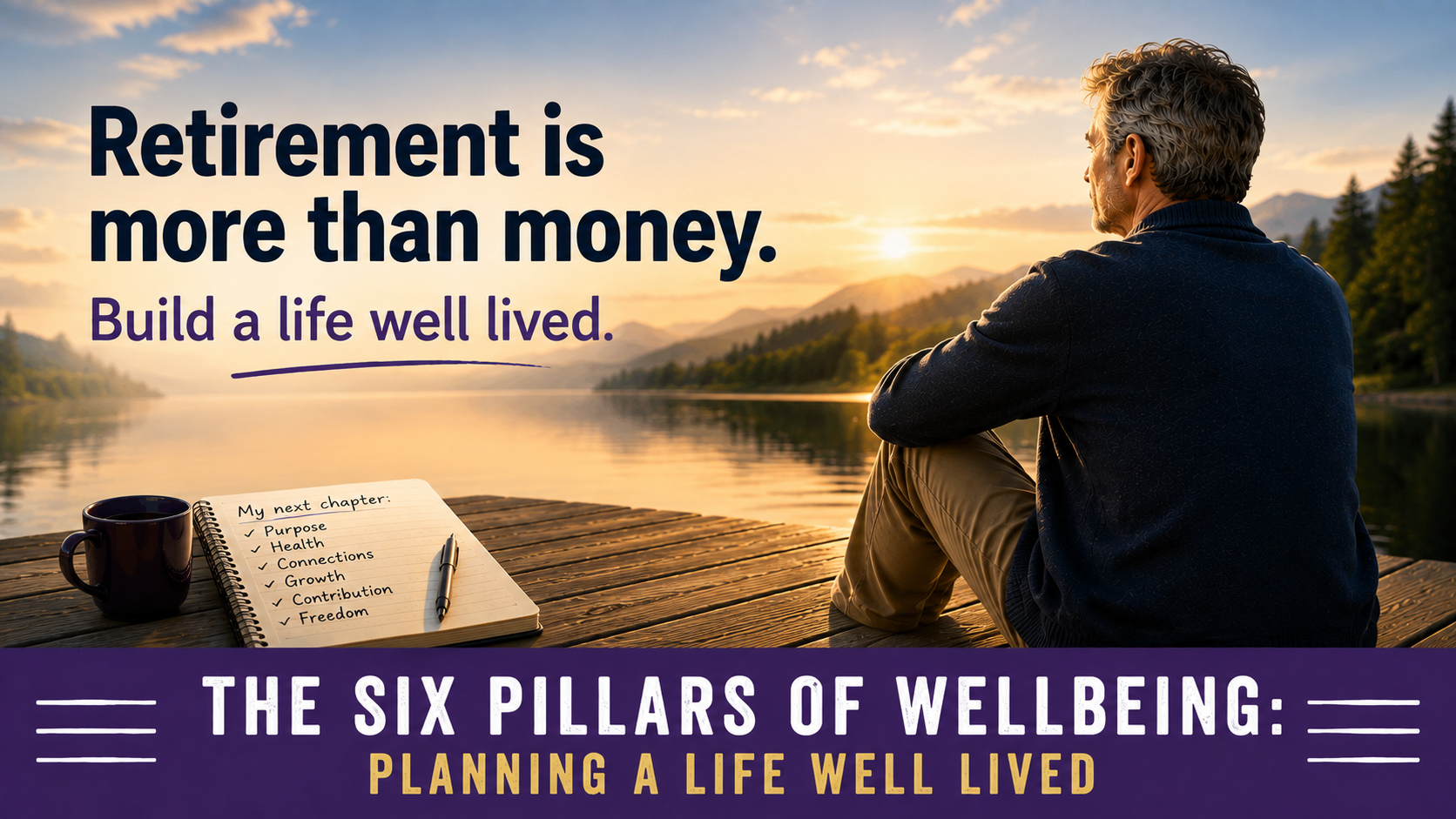
I call them the Six Pillars of Wellbeing.
Retirement planning has changed
For generations, retirement planning was almost entirely about money.
Could you afford to stop working?
Would your pension last?
How much income would you need?
Those questions remain important.
But modern retirement lasts much longer than it once did.
Many people now spend twenty, thirty or even thirty five years in the next chapter of their lives.
That’s too long to think only about income.
It’s long enough to build an entirely new life.
The question becomes:
What kind of life do you want to build?
Wellbeing is built from several interconnected areas
Recent research into retirement consistently reaches the same conclusion.
The people who flourish later in life rarely do so because of one single factor.
Instead, their wellbeing is created through several interconnected areas that support one another.
Financial security matters.
Health matters.
Relationships matter.
Purpose matters.
Learning matters.
Community matters.
When one area becomes neglected for too long, it often begins affecting the others.
Think about poor physical health.
It becomes harder to socialise.
Purpose becomes more difficult.
Confidence falls.
Similarly, persistent loneliness often affects both mental and physical wellbeing.
Everything connects.
That’s why retirement deserves a more holistic approach.
What the World Health Organization says
The World Health Organization defines wellbeing as far more than simply the absence of illness.
True wellbeing includes physical, mental and social flourishing.
In other words, wellbeing isn’t simply avoiding problems.
It’s creating the conditions that allow us to thrive.
That idea sits at the heart of the Six Pillars of Wellbeing.
They aren’t six separate goals.
They’re six connected parts of one meaningful life.
Let’s explore each one.
Pillar One: Purpose and values
If I could encourage everyone approaching retirement to think deeply about one area, it would probably be purpose.
For decades many of us have relied upon work to provide direction.
Work structures our weeks.
It creates routines.
It gives us goals.
It often gives us identity.
Then retirement arrives.
Suddenly all of those external structures disappear.
The obvious question becomes:
What replaces them?
Purpose doesn’t need to involve changing the world.
It doesn’t have to be dramatic.
It simply needs to matter to you.
Ask yourself one simple question.
What would make you excited to get out of bed on a wet Tuesday morning?
That answer may involve family.
Volunteering.
Writing.
Gardening.
Mentoring.
Walking.
Photography.
Learning.
Whatever appears, pay attention to it.
Purpose is deeply personal.
Pillar Two: Financial wellbeing
As a financial planner, I would never suggest money isn’t important.
It is.
Financial insecurity creates stress.
It limits choices.
It creates uncertainty.
But financial wellbeing isn’t simply about having more money.
It’s about having enough.
Even more importantly, it’s about understanding what your money is actually for.
Money is a tool.
It creates possibilities.
It allows experiences.
It provides security.
It supports freedom.
The question isn’t simply:
“How much do I have?”
The better question is:
“What kind of life does this money allow me to create?”
Financial wellbeing also includes our relationship with money.
Many people carry deeply held beliefs about spending, saving and wealth.
Some help us.
Some quietly prevent us from enjoying the life we’ve spent decades building.
Understanding those beliefs is just as important as understanding investment returns.
Pillar Three: Physical wellbeing
There is an old saying that health is wealth.
As we grow older, many people discover just how true that really is.
Money can create opportunities.
Good health allows us to enjoy them.
Physical wellbeing doesn’t require perfection.
It doesn’t demand extreme fitness.
Instead, it asks a much simpler question.
What small improvements could I make today?
Perhaps it’s walking more.
Improving your diet.
Sleeping better.
Building strength.
Reducing stress.
Improving balance.
Moving consistently.
Small improvements compound remarkably quickly.
You don’t need to transform your health overnight.
You simply need to begin.
Physical health supports everything else
Think about everything good health makes possible.
Travelling.
Playing with grandchildren.
Learning new sports.
Volunteering.
Walking holidays.
Gardening.
Meeting friends.
Good health doesn’t guarantee happiness.
But poor health can make almost every other pillar more difficult.
Looking after your body isn’t vanity.
It’s preparation for the life you hope to live.
Pillar Four: Social wellbeing
One of the biggest surprises many new retirees experience is just how much social contact work provided.
Conversations.
Meetings.
Coffee breaks.
Clients.
Colleagues.
Casual interactions.
These often disappear overnight.
Many people underestimate how significant that loss can feel.
Research consistently shows that loneliness is one of the greatest risks facing older adults.
The effects extend far beyond emotional wellbeing.
Loneliness has been linked to poorer physical health, lower resilience and reduced quality of life.
Social wellbeing doesn’t require a packed diary.
It simply requires meaningful connection.
One close friendship is often worth far more than dozens of acquaintances.
Build relationships intentionally
Retirement rarely creates friendships automatically.
They often require deliberate effort.
Arrange regular coffees.
Join clubs.
Attend local groups.
Reconnect with old friends.
Invite people for lunch.
Make the first move.
Relationships thrive when we invest in them.
Pillar Five: Community wellbeing
Although closely connected to social wellbeing, community wellbeing is slightly different.
Social wellbeing focuses on relationships.
Community wellbeing focuses on contribution.
It asks:
Where do I matter beyond myself?
Human beings naturally want to feel useful.
We like knowing that our presence makes a difference.
Community can take many forms.
A sports club.
A church.
A charity.
A local history society.
A book club.
A volunteer organisation.
A neighbourhood project.
Contributing to something larger than ourselves provides meaning that leisure alone rarely achieves.
Giving back benefits everyone
Contribution isn’t simply good for the people receiving it.
It’s good for us too.
Helping others creates purpose.
It strengthens relationships.
It builds confidence.
It reminds us that we still have something valuable to offer.
Many people discover that giving back becomes one of the most rewarding parts of later life.
Pillar Six: Intellectual and occupational wellbeing
Retirement doesn’t mean your brain retires.
Curiosity remains one of the greatest gifts we possess.
Learning.
Reading.
Studying.
Creating.
Teaching.
Problem solving.
All of these keep the mind active.
Research increasingly suggests that intellectual engagement supports long term cognitive health.
The goal isn’t necessarily returning to work.
It’s remaining mentally stimulated.
Some people continue working part time.
Others learn languages.
Join the University of the Third Age.
Take online courses.
Read widely.
Write.
Teach.
Start businesses.
The opportunities are almost endless.
Curiosity creates energy
One of the most noticeable characteristics of people who thrive later in life is curiosity.
They remain interested.
They continue asking questions.
They enjoy learning.
They seek new experiences.
Curiosity brings freshness to everyday life.
It reminds us that growth doesn’t stop simply because work ends.
The pillars support one another
Perhaps the most important thing to remember is that none of these pillars exists independently.
Learning often creates friendships.
Exercise improves confidence.
Financial security enables travel.
Purpose encourages healthier habits.
Community strengthens social connection.
Everything overlaps.
That’s why trying to optimise only one area rarely produces lasting fulfilment.
The strongest lives are balanced across all six.
Which pillar needs your attention?
A useful exercise is simply assessing where you are today.
Ask yourself honestly.
Which pillar feels strongest?
Which one feels weakest?
Most people quickly identify one area that’s thriving.
They also recognise another that’s been neglected.
That’s perfectly normal.
The goal isn’t perfection.
The goal is awareness.
One pillar. One experiment.
Rather than trying to transform your entire life, choose one pillar this week.
If purpose feels uncertain, spend time reflecting on the moments you’ve felt most alive.
If physical wellbeing needs attention, commit to walking every day.
If social wellbeing feels weaker, arrange coffee with someone you’ve not seen for months.
If intellectual wellbeing needs work, begin a new course or read a book outside your usual interests.
If community is missing, explore local volunteering opportunities.
If financial wellbeing causes anxiety, book time to review your finances properly.
Small changes often produce surprisingly large results.
Build momentum gradually
The beauty of this framework is that progress doesn’t require dramatic action.
Tiny improvements accumulate.
One extra walk.
One meaningful conversation.
One hour spent learning.
One act of kindness.
One financial review.
Over time these become habits.
Habits become lifestyle.
Lifestyle shapes wellbeing.
Financial security is the foundation, not the destination
Perhaps the biggest lesson I’ve learned from working with clients is this.
Money creates options.
It does not create fulfilment.
Financial security forms the foundation upon which a great next chapter can be built.
It is not the finished building.
The life itself still needs designing.
That’s where the Six Pillars of Wellbeing become so valuable.
They remind us that retirement isn’t simply something we can afford.
It’s something we intentionally create.
Final thoughts
Preparing for retirement is about much more than calculating pension income.
It’s about preparing for life.
Purpose.
Financial wellbeing.
Physical health.
Social connection.
Community.
Intellectual curiosity.
Together these six pillars create a framework for living well.
If you strengthen each one, even gradually, you dramatically increase the chances that your next chapter becomes one of the richest and most rewarding periods of your life.
Money may provide the opportunity.
But it is these six pillars that transform opportunity into a life well lived.
Continue Planning Your Next Chapter
If you’d like to explore the Six Pillars of Wellbeing in greater depth, along with practical exercises to help you design a meaningful next chapter, you’ll find them in my book What Happens Next: Ditching the Retirement Script for a Life Well Lived.
Drawing on more than twenty years of experience as a Chartered Financial Planner, conversations with leading experts and the ideas explored throughout the What Happens Next YouTube channel, the book provides practical tools to help you build a life that’s not just financially secure, but rich in purpose, health, relationships and fulfilment.
Whether retirement is just around the corner or still a few years away, it’s never too early to start designing the life you want to live.
Buy your copy today: https://www.amazon.co.uk/dp/1918097720